
An Uncivil Discourse on Wine
To get a wine lover pissed - as opposed to "pissed" - just say "alcohol free"!

January brings great football, all the more enjoyable when I don’t have a team in the hunt.1 Unfortunately, it also brings Dry January, with sanctimonious posturing and a New Prohibition media blitz trying to shame us into surrendering our favorite tipple. “This is your liver on wine” ads have nearly overtaken the 30-day Tai Chi walking challenge in my social media feeds.
Last year I posted “Down With Dry January!”, something I almost certainly wouldn’t have been able to write for my Washington Post wine column.2 I decried the performative virtue-signaling and public shaming involved in a campaign for 31 days of abstinence rather than a lifetime of moderation and responsible consumption.
In the past week or so, there has been a collective belch of anti-Dry January screeds from the bibulous contingent here on Substack, so I won’t add to that here. (I’ll link to a few of my favorites below.) Instead, I want to pull a thread from the chatter to explore a subject I suspect will merit thoughtful discussion if we can ever get beyond the emotion. Right now, it all seems pretty divisive.

A Not-So-Civil Discourse …
There’s something in the American psyche that looks down on alcohol consumption as a weakness, or a sin. Those who do imbibe therefore feel defensive. Neither attitude is constructive.
On LinkedIn recently, Rachel Martin, founder of Oceano wines from the San Luis Obispo Coast AVA in California and Oceano Zero alcohol-free chardonnay, pinot noir and syrah, posted about a new organization she co-founded with two other beverage professionals, called AFicioNAda, or AFNA. The group is offering certification programs for sommeliers, bartenders and others in the food and beverage trade on “alcohol free and non-alcoholic” beer, wine, spirits and cannabis-infused adult beverages.
“[E]xpanding choice isn’t enough on its own. As the category scales, quality—and the ability to explain it—becomes the differentiator,” Martin wrote. “Leadership comes from being able to articulate why one AFNA (Alcohol Free Non Alcoholic) wine is different from another—how it’s made, what decisions were taken, and how those choices show up in the glass.”
The certifications will help generate a “fluency” among the trade by “establishing shared standards and a common language for a category that is now driving real commercial value,” she added.
Even on such a staid platform as LinkedIn, Martin’s post touched off a firestorm.
The so-called No-Lo sector of zero or low alcohol wines is still a tiny but rapidly growing sliver of the market aimed to appeal to people who want to cut back on alcohol consumption. “Know your limits,” after all, means knowing when you’ve reached your limit. And people who want to cut back their consumption shouldn’t have to give up wine and the experience of wine altogether. This is — or should be — part of the ideology of wine as a cultural treasure that forges connection and community. Abstainers shouldn’t be left out or relegated to sipping ginger ale or Martinelli’s sparkling cider.
These wines have faced two major problems. First, traditionally they’ve sucked. Removing alcohol from wine ruins its balance, strips its aromas and leaves a sharply acidic mess needing “correction” with sugar. Technology is improving, though, allowing more of the esters to be recovered and added back to the wine and leaving the de-alcoholized product more wine-like.
The second problem: Too many wine lovers are convinced that zero alcohol wines have always sucked and always will suck.3 These are the people who lit into Martin in the comments on her post.
“Maybe someone could find a way to make it actually taste good. Until then maybe try one of the other 10,000 things humans can drink that have no alcohol,” wrote one wag, adding, “also if anyone is going to pay more than $30 for a bottle of wine it better have alcohol in it.”
“That reaction made sense a few years ago,” Martin replied. “What’s changed is the technology—alcohol removal, aroma recovery, and finishing techniques have improved dramatically, and quality is following.”
AFicioNAdo’s efforts to educate the trade on these beverages is a sign that the sector may have legs, so to speak. Another is news that French Bloom, a brand of alcohol-free sparkling wine, purchased an estate in southern France (Limoux, the “birthplace” of sparkling wine) specifically to produce alcohol-free sparkling wine.
Is demand following, though? A retailer commented: “We sell 1000 wine skus - we have NEVER once been asked for Non Alcoholic ‘wine’. We are a wine store not a soft drinks seller. The Non Alcoholic wine is not wine.” He added a mic drop emoji.
That last sentiment sparked an extensive debate in the comments to Martin’s post. Can or should wine that no longer contains alcohol be called “wine”?
“[W]ine without alcohol isn’t wine. It’s a different beverage category, and pretending otherwise muddies the conversation,” another commenter wrote. “Wine, by definition, is fermented grape juice with alcohol. Remove the alcohol and you’ve created a different beverage category - which is fine - but it’s not wine.”
This argument, along with the above comment that expensive wines “better have alcohol” suggest that what we value in wine is the alcohol itself, not the historical or cultural significance, nor the connection it offers. That’s probably not what these commenters intended to say when emphasizing alcohol as a crucial component of wine. But it is rather suggestive, in an “In vino veritas” sort of way.
And it’s unnecessarily dismissive of the efforts by Martin and others to present choices to those who want a gastronomic beverage sans alcohol. Admittedly, “de-alcoholized wine” sounds brutal, especially in an age when we value minimal manipulation. But there are other options, including “wine alternatives” that are “built from the ground up” rather than stripped down. These drinks are never fermented into alcohol which is then removed, but crafted with botanicals and other flavorings to mimic the complexity and savoriness of wine. A New York company called Unified Ferments combines tea and kombucha to make “a non-alcoholic offering that sits comfortably in stemware.” That’s the closest they come to mentioning wine on their website.
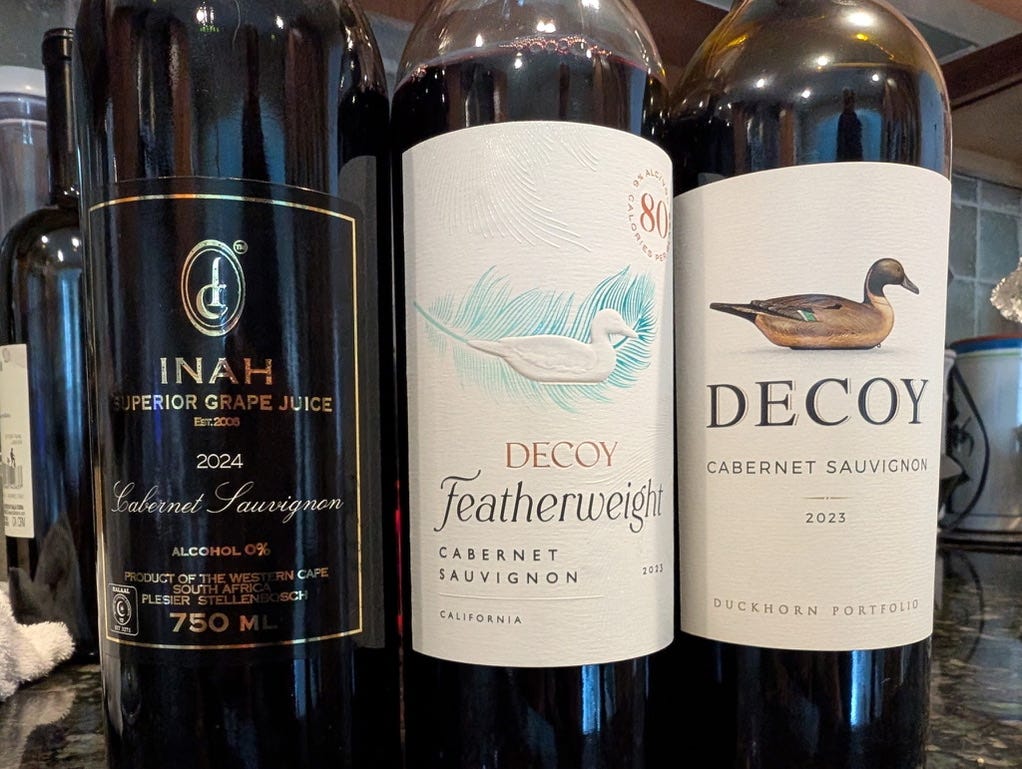
Last week, I bought a bottle of Cabernet Sauvignon in a health food store run by the Seventh Day Adventist Church. The brand was Inah, from the Western Cape of South Africa. It’s vintage dated 2024, in a Bordeaux-style bottle with a cork, contains sulphites, with Halaal and vegan-friendly stickers suggesting certifications. No nutrition labeling or government warning. “Ingredients: 100% Cabernet Sauvignon grapes,” suggesting no added sugars. From across the room, you’d think it’s wine, even though the label never uses that word. Instead, “superior grape juice” is emblazoned on the front label.
It was delicious. It tasted like Cabernet Sauvignon, with the black currant / cassis notes we all love. It’s off-dry, as the natural sugars were never fermented into alcohol. But it wasn’t cloying like certain California concoctions meant to appeal to the American sweet tooth.4 I tried it alongside two Cabernet Sauvignons from the Duckhorn portfolio, Decoy 2023 and the new Decoy Featherweight 2023, a reduced-alcohol cabernet clocking in at 9% abv and 80 calories per glass. The Inah was $20, and the two Decoys were priced in the mid-$20 range, so roughly compatible.
They were all delicious and all very different. The Decoy Featherweight works — as a cabernet that just gets over the line of gain, to use a football analogy. It’s light, chillable, and crunchy in acidity. At a cool room temp, it’s quite tasty. It won’t get 100 points from anyone, but it isn’t trying to. It just wants to make you smile. And if it doesn’t, or if it doesn’t meet your ideology of what wine should be, don’t denounce it. Just drink something else.
As the AFNA sector grows, we’ll probably find ourselves debating the very meaning of wine. (I’m looking at you, Oat Milk!) Is it simply fermented grape juice? Is it a cultural or gastronomic experience? Is it all of the above? Is there room in the definition for wine without the buzz?
Wine may be reinventing itself here. (On any number of fronts!) In my 30 years writing about food and wine, I’ve learned not to be casually dismissive of anyone trying something different.5 Let’s not close our minds to innovation. Ultimately, the market will determine the success or failure of alcohol-free or low-alcohol wines and wine alternatives.
But I’m not going to look askance at anyone who produces AFNA beverages or prefers them on any occasion, and I may even find occasion to enjoy them myself.
Here are some good NA wines I’ve tasted recently:
Selbach Funkelwürtz Zero, Dealcoholized Sparkling Wine, Germany. Riesling seems to be the best variety for AF wines, perhaps because of the grape’s sweetness. Okay, this one tastes like apple juice, but really good apple juice.
Chavin Pierre Zero Signature, Dealcoholized Sparkling Chardonnay. This French brand, imported by Kobrand, has several AF sparklers priced around $20. They are quite good. Much cheaper than French Bloom, which has Champagne ambitions (and connections).
Giesen 0 Spritz, New Zealand. Giesen has been a leader in dealcoholized wines, blending back some unfermented grape juice to compensate for the flavors and body lost in the alcohol removal. The Giesen Spritz are tasty, enjoyable aperitif-style drinks, in a white and a rosé. They are available in 4-packs of 250ml cans for $21 or in 750ml bottles under crown cap for $16.
And here are other commentaries on Dry January


And on Stat10, Robert M. Kaplan, a public health scholar at Stanford, looks at the scientific evidence cited by the Dry January folks and says … eh, no thanks.
That Ole Miss - Georgia game was amazing! 🤩
To be honest, I never pitched the idea, an example of self-censorship, perhaps, more than self-restraint.
This reminds me of an acquaintance who, in about 2012 or so, said to me, “I tasted a Virginia wine back in the ‘70s, and it really wasn’t good.” This attitude, though much rarer today, still persists.
Cough cough Meiomi cough cough Apothic cough cough
Okay, maybe piquette.
Thank you for taking this on so thoughtfully, Dave. I appreciated your willingness to leave the question open rather than resolve it, and to name the unease around intervention. What feels important to add is that the wine world is also navigating a parallel value: openness to innovation when it meaningfully improves experience. We see this across categories—from skincare to nutrition—where scientific advances are embraced not as shortcuts, but as tools. Holding space for both minimal intervention and thoughtful innovation feels like the real work right now, and I’m glad you allowed that complexity to stand rather than collapsing it into a verdict.
I appreciate this because I've talked to local winemakers who haven't been pleased with NA wine, and so I've been dismissing it as a category with little further thought. It resonates with me that advances in the technology behind winemaking and alcohol removal, as well as rethinking how we make beverages to avoid fermentation into alcohol can create better stuff that can be just as interesting as the wines I love. Thanks for an article that pushed my thinking on this topic.